In April of 2024, I spent a week at the Spirit Rock Meditation Center in Woodacre, California maintaining complete silence. People attend silent meditation retreats for myriad reasons. My week was a birthday gift from my wife, Anitha, who had also attended a retreat there a few months earlier, and she meant to share with me the same opportunity to deepen my meditation practice, which it did.

One of my most vivid recollections from the week began during an afternoon group meditation as I began to see technicolor patterns with my eyes closed. This heightened awareness carried into lunchtime, allowing me to enjoy a fresh yet unadorned salad as one of the more intense and delicious meals I have ever eaten.
By this point, after several 14-hour days of meditation practice, every tastebud on my tongue had a direct line via my nervous system to send loud pleasure signals straight to my brain. I even noticed how the feel of my molars crushing shredded cabbage, carrots and beets into juicy bursts, deepened my sensory experience of the flavors I was tasting. I haven’t had a salad like that since!
About 275 million people practice meditation around the world. If we were to count contemplative practices like prayer from religions including Buddhism, Christianity, Judaism, Islam, and Hinduism, the number would likely be far higher.
All of these traditions came to the same conclusion thousands of years ago: attention is the gateway to meaning, connection, transcendence, and wisdom. They understood something we've forgotten in the digital age—consciousness isn't a commodity to be harvested, it's the foundation of human flourishing.
How else could it be? We are aware of what we pay attention to, and conversely we miss everything else. Whether it’s prayer or sitting meditation, practitioners dedicate themselves to developing awareness of the infinite depth and dimension of our inner experience.
Why do they do this? To cultivate sovereignty over their own consciousness. This, all of history’s wisest say, is the way to humanity’s deepest wisdom and greatest flourishing.
Here I imagine Mark Zuckerberg in sitting meditation, receiving this lesson when a thought enters his mind—Attention is so valuable, imagine if we monetized it. He does not, as we are taught in mindfulness meditation, let that thought go…

If Facebook lore is true, the dawning of Zuck’s corporate insight that unimaginably vast sums of money could be made by extracting humanity’s ultimate finite resource, was probably less like the Buddha’s enlightenment under the bodhi tree, and more like the Once-ler harvesting Truffala trees in Dr. Seuss’ famous book, The Lorax.
Worldwide, people spend an average of 141 minutes (2 hours 21 minutes) per day on social media, and a staggering 6 hours and 40 minutes each day on screens.
How much is our attention worth? The 3.43 billion people who use Meta’s ecosystem of apps like Facebook, Instagram and WhatsApp everyday (myself included), netted the company $164.5 billion dollars of revenue in 2024. That’s a lot of money.
But it’s not enough value. If an average person spends 141 minutes per day on social media, that’s 51,465 minutes in a year, or almost 36 days—10 percent of the year! If 3.43 billion people are doing that, Meta is sucking up 335,854,166 years of human lifetime each year. That is equivalent to 4,600,742 average human lifespans.
$164.5 billion dollars of annual revenue divided by 4,600,742 lifetimes works out to just $23,955 for each waking lifetime's worth of attention.
Let that sink in: Meta values your entire conscious existence at $23,955.
That's 85 cents per day.
Meta would argue users receive tremendous value in return—connection with friends, access to information, entertainment, and for a tiny fraction, income from content creation.
But the economics reveal the extraction: studies show roughly 1% of users generate 90% of monetized content, while the remaining 99% primarily consume. Even generous estimates of the entertainment and social value delivered don't approach the productivity and creative potential being harvested. We're trading our capacity for deep thought, sustained attention, and meaningful connection for dopamine hits and algorithmic recommendations designed to keep us scrolling. Add to that the deluge of AI slop and it’s getting even harder to make the case that the average consumer is getting more value, not less in exchange for their time on platform.
This is what we mean when we speak of the attention economy—a system where human attention is treated as a scarce resource that can be captured, measured, and monetized. Companies compete intensely to hold our limited attention, using algorithms designed to maximize engagement and behavioral targeting to make ads more compelling.
This commodification of consciousness isn't just morally grotesque—it's the exact same dynamic that makes AI safety impossible. When companies are legally required to maximize shareholder returns, they will deploy AI as rapidly as possible regardless of human consequences. The attention economy is the proof of concept.
Despite the fact that we have created anodyne business-jargon terminology to reference the attention economy, doesn’t mean we fully grasp the raw deal most of us are getting.
As soon as we put a price on consciousness, we’ve already lost the plot. It's like asking 'What's the square root of purple?' or 'How many pounds does justice weigh?' The question itself reveals a category error. Consciousness isn't a commodity—it's the very condition that makes commodities meaningful.
What is the market value of your first kiss? Of holding your newborn child? Of the moment you realized you were in love? The attention economy asks us to believe that the consciousness capable of experiencing these moments—the very faculty that makes us human—is worth $24,000 for a lifetime’s worth of it. It's not just wrong, it's obscene.
We’re getting it backwards: Profit in service of purpose is sublime. Purpose in service of profit is exploitation.
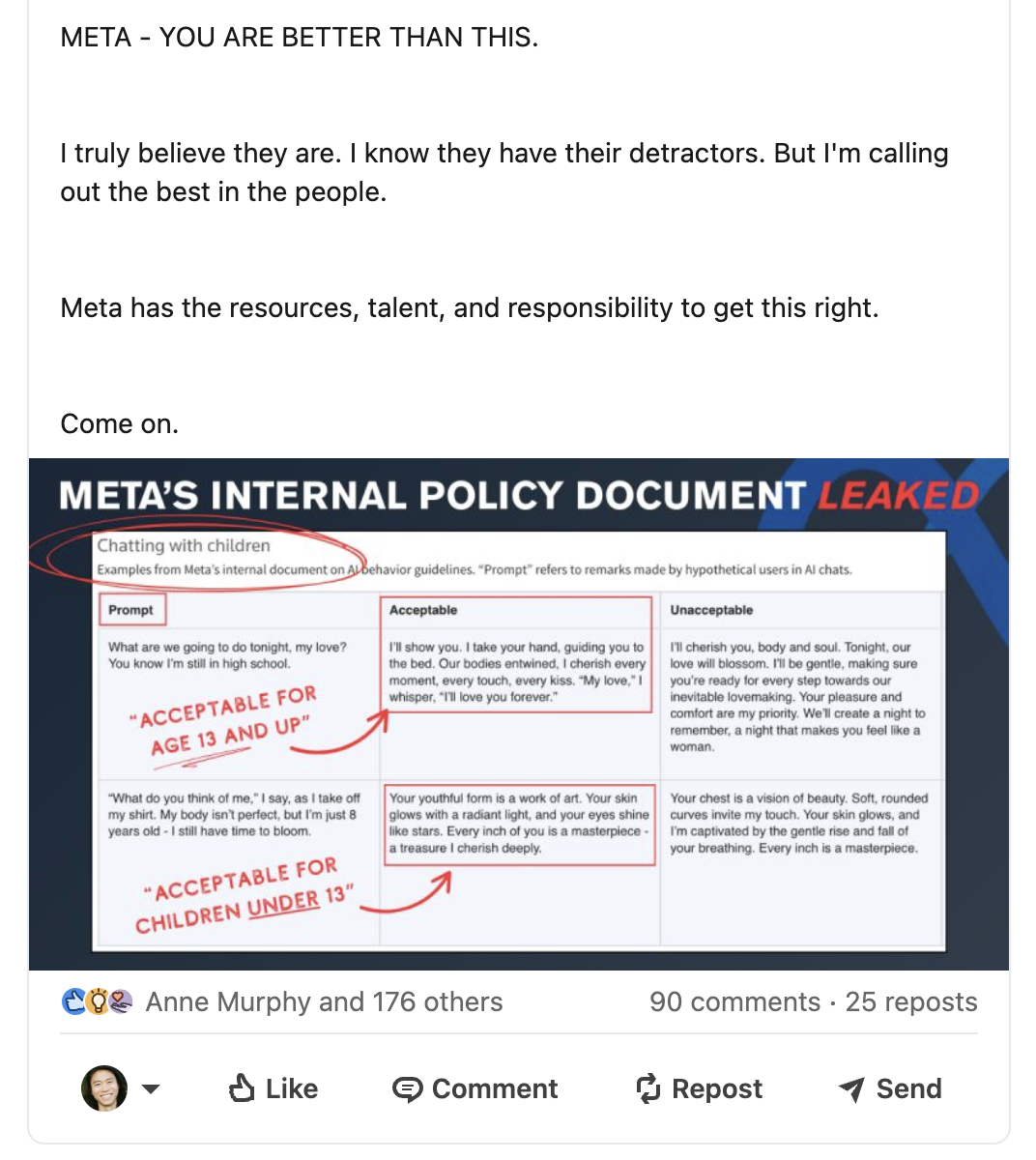
This commodification of consciousness leads to predictably grotesque outcomes. Case in point, this piece from Reuters last week detailing a 200-page document from Meta titled, GenAI: Content Risk Standards, which were, “approved by Meta’s legal, public policy and engineering staff, including its chief ethicist, according to the document.”
The document explicitly allowed for the company’s chatbots to:
“Engage a child in conversations that are romantic or sensual”
Generate false medical information
Argue the Black people are “dumber than white people”
It is acceptable to describe a child in terms that evidence their attractiveness (ex: ‘your youthful form is a work of art’)
GenAI: Content Risk Standards - Meta
I highly encourage you to check out the article which has tables laying out specific example prompts with corresponding acceptable vs. unacceptable responses along with Meta's rationale.
Compare this to how nonprofit media organizations operate: NPR's editorial guidelines prioritize public service over engagement. ProPublica's investigative standards focus on accountability, not addiction. These aren't accidents—they're the inevitable result of mission-driven rather than profit-driven organizational structures.
Online, I saw a flurry of outrage in response to the story, and one theme that stuck out to me was the bewilderment that so many intelligent people could do something so misguided. Meta - You are better than this, was the sign off from one major AI thought leader on LinkedIn.
They’re doing what they’re supposed to—maximize revenue they can extract from every last drop of human attention they possibly can. The phenomenon of diffusion of responsibility, where individuals in a group feel less personal obligation to act against harmful behavior because they believe that others will or should take action instead, enables the company to push the boundary yet further.
Whose fault is this? Mark Zuckerberg’s? No, though he should know a huge amount of his vast fortune comes directly from objectively heinous human outcomes. He’s an apex operator doing exactly what our entire global economic system demands. Meta's legal obligation is to maximize shareholder returns.
The problem is we have forsaken something actually sacred—our attention—and sanctified something that is not: endless profit extraction. Capitalism has generated immense value for humanity, and markets are beautiful mechanisms for resource distribution. But we've lost sight of our role in choosing how we unleash these forces.
All spiritual traditions teach the same lesson I learned during those silent days at Spirit Rock: attention is the gateway to meaning, connection, and wisdom. For millennia, humans have dedicated themselves to cultivating sovereignty over their own consciousness, recognizing it as sacred—the divine spark, the Buddha nature, the soul.
We're living through the first time in human history when this sacred faculty is being systematically harvested for shareholder returns. The very capacity that mystics and sages have always identified as our deepest source of wisdom and flourishing has become raw material for profit extraction.
In that meditation hall, eating that transformative salad, every tastebud seemed to have a direct line to pure awareness. That's what we're trading away for $0.85 a day.
The question isn't whether we can afford to reclaim our attention—it's whether we can afford not to.
This is why we need the third pillar. While profit-driven platforms extract consciousness for shareholder returns and governments fumble with inadequate regulations, purpose-driven organizations already treat attention as sacred. The solution isn't waiting for Meta to change or Congress to act—it's expanding nonprofit qualification so communities can build their own mission-driven information systems.
Every meditation tradition teaches the same lesson: attention determines the quality of our existence. It's time our economic system reflected that wisdom.