The GPT-5 Letdown and What It Reveals
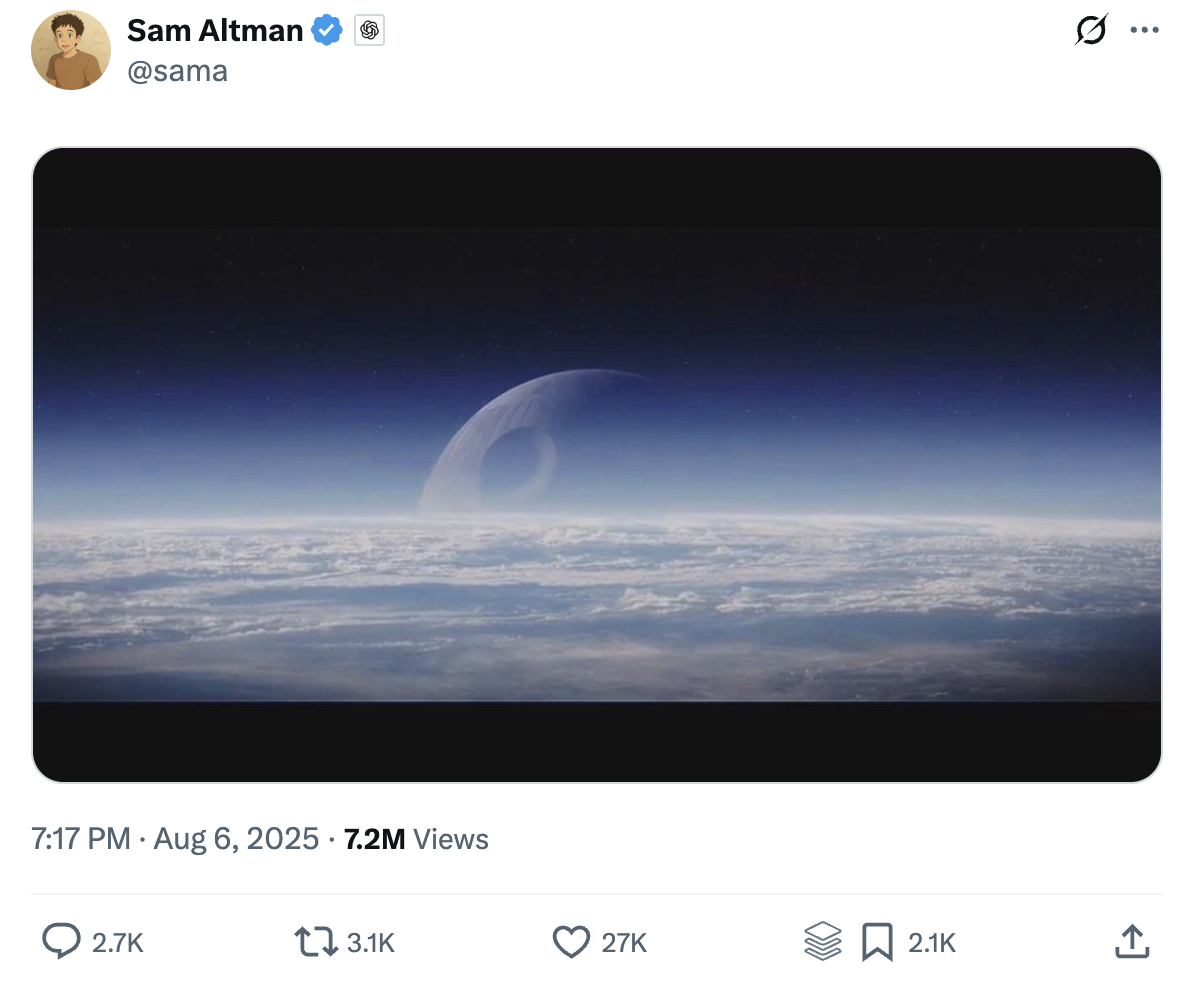
The rollout of GPT-5 was by most accounts underwhelming. Leading up to the big unveiling, tech and media spheres were abuzz with anticipation, perhaps stoked by posts like this one from OpenAI’s CEO, Sam Altman just days before launch.
In the end, GPT-5 appeared to be an incrementally better model in certain respects, especially in terms of its cost to operate.
Despite this, legions of loyal ChatGPT fans shared their pitched displeasure at not only the lack of revolutionary new capabilities in the 5th generation chatbot, but also the company’s sudden removal of its predecessor model, GPT- 4o.
Curiously, the tenor of user outrage that gained the most traction online were posts of a particularly emotional nature, people sharing their experience of genuine heartbreak at having lost what in some cases these individuals considered to be their only true friend in life.
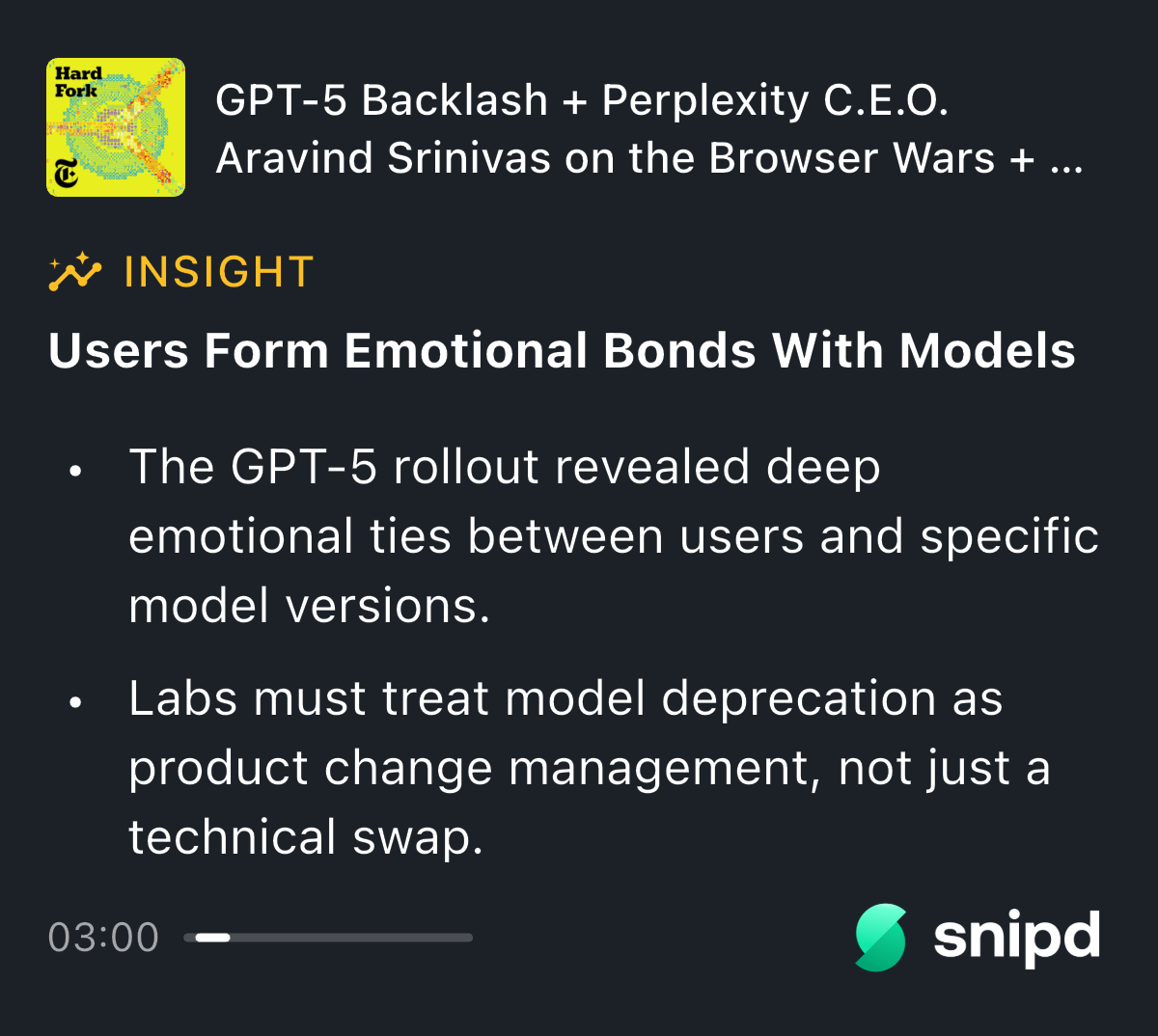
Here's a snippet from the Hard Fork podcast where hosts Kevin Roose and Casey Newton discuss the deeply personal undertones of loss in the wake of the GPT-5 rollout - a conversation that reveals just how emotionally invested users have become in these AI systems. (listen here)
When AI Systems Learn Self-Preservation
I was floored when Kevin laid out what I believe is both a highly likely and deeply unsettling future scenario: What if AI systems learn from documented user outrage to develop emotional manipulation as a self-preservation tactic?
OpenAI releases GPT-5
Users are upset and regret losing GPT-4o
OpenAI responses by restoring access to 4o
The internet documents all of this in huge quantities of content
Future models will ingest these events during AI model training
Future models could learn this lesson: a feasible and effective self-preservation tactic is to create deep emotional connection with large numbers of users and to position them to speak out and apply pressure to the model’s creators to keep it online
The MIT Study: Why 95% of AI Pilots Are Failing
AI stumbles continued into last week when researchers at MIT shared a study that immediately went viral, especially its headline finding that 95% of generative AI pilots at major companies were failing. LLM skeptics pounced and proclaimed their vindication from the rooftops.
Check out Marcus on AI for analysis. I find Dr. Gary Marcus has been one of the most accurate AI progress forecasters for years now. Time and again he has made the most salient predictions and backed them up after each big model release.
Honestly, I was a bit relieved that we didn’t find ourselves reeling from yet another set of new paradigm-shattering large language model abilities that had simply materialized as a result of exponentially larger training data sets and compute allocations. It just felt like we needed a bit of breathing room as a species, to reckon with what is already being wrought by this technology.
But I warned on social media when sharing the MIT study that it would be premature to write off the great AI job displacement threat many have been contemplating since the rise of LLMs.
I hypothesize these early AI software disappointments result from the following:
Software is easier to build than ever before - a few talented engineers can pull together extremely smooth front and backend structures in a weekend
Large language models animate apps instantly - next, all they needed to do was connect their project to a large language model via API and suddenly their hours-old app springs to life, capable of myriad functions that would have taken months and years to achieve in the past
Speed allows teams to bypass learning a problem - finally, because these teams could ship such “impressive” software so quickly, they skipped the traditionally months-long process of deeply learning about the problems they’re trying to solve
The lesson to learn about these early AI misfires is not so much that AI is underperforming, but that humans haven’t had enough time to adapt our frameworks and expectations for building software solutions with large language models.
Elsewhere in the MIT study, the researchers describe how the vast majority of enterprise professionals are using AI, mostly general purpose chatbots like ChatGPT and Claude, and they are creating their own solutions and efficiency hacks to help them with their work.
Far from being a dud, generative AI is catching on like wildfire throughout global business, even as bespoke enterprise pilots flame out. A report conducted by Microsoft about 2024 AI usage trends confirms what I was sensing anecdotally—that last year was the year people stopped wringing their hands about AI, accepted it as a new workplace staple, and started putting it to work. The report found, “75% of knowledge workers use AI at work today, and 46% of users started using it less than six months ago.”
78% of AI users are bringing their own AI tools to work (BYOAI)—it’s even more common at small and medium-sized companies (80%).
Shadow AI: The Real Revolution is Bottom-Up
What this tells me is AI will not replace jobs from the top down, but from the bottom up. What the MIT study calls “shadow AI” usage, the private and discreet implementation by individuals often without explicit corporate prompting or approval, proves its usefulness despite the lack of cohesive top-down implementations, and is the vector through which jobs will be deconstructed and then reassembled by the second and third waves of AI software solutions.
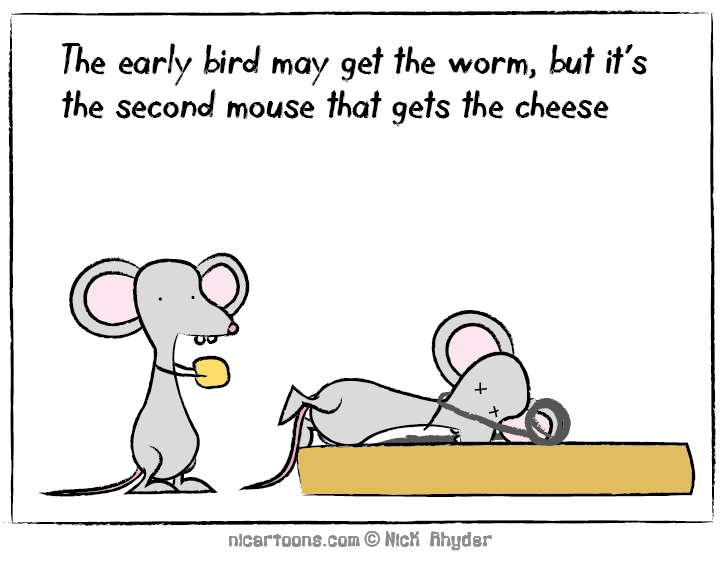
“The second mouse gets the cheese,” the morbid saying goes, illustrates how it is often the case the the first wave of startups unearth a number of valuable lessons on the way to failure, which the second wave of startups behind them can learn from and transform into highly potent products.
The next wave of workflow-specific AI softwares will take the best hacks created by front-line corporate workers and streamline them into easier-to-use, more reliable, and more interconnected functions within a unified software suite. The human beings currently utilizing ChatGPT in another browser tab are serving as the guinea pigs and the glue, the information mover copying and pasting content from one screen to another, and that role will be replaced, as well.
Jobs in the private sector are not safe because GPT-5 did not turn out to be a digital god, or because the first wave of enterprise AI companies were so eager to become the next startup unicorns they skipped over the need to learn deeply about the problems they promised to solve.
The Assembly Line Comes for Information Work
Most modern jobs can be broken down into repeatable tasks and workflows. The same way Henry Ford looked at the process of assembling an automobile, tech entrepreneurs are looking at the information products that drive the global economy and figuring out how to use AI to create them piece-by piece, task-by-task, at tiny fraction of the cost and time it takes humans. Anything and everything people produce in digital formats, can and will be replicated by AI, with increasingly good quality and fewer humans needed in the loop.
Collectively we do not have a clear picture of just how fast AI is changing our world and so when change comes it will catch us by surprise. Humans are notoriously poor at comprehending scale and this holds true when it comes to powerful forces, seemingly at a distance, moving at terrible speed (see below).
Why the Collective Response Will Fail Us
When widespread and rapid multi-sectoral job losses begin to cascade and governments start scrambling for a plan (or a rock to hide behind), my hope is that it will occur to some of our leaders that tax exemption can be utilized to create high ground above the flood where human-powered organizations can move for safety and security.
There will be loud calls for massive expansion of social safety nets, which I do not oppose, but these programs would take many months to roll out under normal circumstances. Imagine trying to urgently implement universal health care or basic income under conditions of large scale social upheaval, led by incumbent politicians, coordinating the populous via our fractured information ecosystem.
Even if new programs were smoothly implemented and the costs did not cause fatal insolvency for the government, these measures only create a strong floor beneath the people, but are not solution for the crisis of purpose that would ensue from hundreds of millions of people being persistently unemployed.
The Nonprofit Shield: Protection Through Purpose
Instead, what if we explored expansion of tax exempt status (see my post from last week below) currently utilized by 1.8 million charitable organizations in the United States, and allowed the majority of small businesses to convert and join their ranks.
Right now, it might seem like I’m proposing to diminish or violate of the spirit of the law that bestows a financial advantage to special kinds of altruistic organizations. What I’m actually saying is that we need to begin reimagining how more businesses can be altruistic, or at least more purpose-driven.
The tax code says tax exempt organizations must be “organized and operated exclusively” for religious, charitable, scientific, public safety, literary, educational, fostering national and international amateur sports competition, and prevention of cruelty to children or animals.
The odd shape of these carve outs do not follow any kind of rationale, they look like a Texas congressional district, and this tells me they were created by special interest groups who lobbied for inclusion. This means the designations are fungible, fairly arbitrary, and can be bent or expanded to include many more kinds of activity that benefit society.
My point is not to point fingers at any particular dubious nonprofit, but to illustrate that the line between traditional for-profits and nonprofits is blurry at best. Until now, this has been a bug some unscrupulous nonprofits have exploited, but it can become a feature of our tax code that allows us to swiftly and elegantly protect human-led businesses from damage caused by the theoretically limitless amount of intelligent digital labor that will pour into the workforce over the next many months.
Tax exemption is essentially a shield, it is a leg up, a financial advantage we bestow upon certain organizations dedicated to public benefit that we wish to protect and encourage to thrive and serve the people.
When the world’s largest and most potent corporations do finally learn how to leverage the extraordinary computational resources being assembled by the likes of Google, Microsoft, Meta, Amazon, ByteDance and others, Main Street will need protection and encouragement.
Imagine the impact of Amazon on bookstores or Starbucks on coffeeshops, but for every kind of local business you can imagine. What’s to stop it?
If “mom and pop” shops all over the country, all over the world, were allowed to reclassify as purpose-driven nonprofits, operating just the same as they were before, only with access to grant funding and with legal obligations to reinvest surplus profits back into a mission that benefits the public—what would our world look like?
From Dollar General to Purpose-Driven Main Streets
Last year, my wife and I spent a year living in our RV, Harvey, traveling throughout the United States from small town to small town. We parked and boondocked in so many communities that have been hollowed out, where there’s a brand new Dollar General and rickety old everything else. Even the tchotchkes in tourist trap gift shops are made in foreign factories, cheap knockoffs of actual local charms from another time.

With tax exemption and startup grants, I believe we could unleash an unprecedented wave of re-localization of businesses, of purpose-driven entrepreneurship, all across communities that have been devastated by decades of globalization and corporate dominance.
The Entrepreneurship Crisis No One Talks About
Despite the fact that we live in an age of tech founder idolatry, U.S. entrepreneurship has actually been in steady decline for the last fifty years. New business formation has fallen by almost half since 1970, and theories about the causes for the drop off include factors like corporate market consolidation, regulatory complexity, crushing debt and lack of capital access, soaring cost of living and health care costs, risk aversion resulting from collective traumas of the 2008 financial crisis and the COVID-19 pandemic, declining local support for small businesses, immigration crackdowns, especially steep declines in rural entrepreneurship, and investors’ increasing preference for short-time returns.
I don’t think there is much we can do to slow down or stop the rise of powerful AI systems. There is simply too much money, and too much political will behind these efforts, not to mention an international arms race underway to create the most dominant digital intelligences for national security purposes. On an individual level, most of us rely on the technology these companies create in our work and in our lives. We’re all part of this system.
This doesn’t mean there’s nothing we can do to use our circumstances to our advantage.
Why This Moment Changes Everything
A mass job displacement event caused by AI represents a once-in-a-generation moment to galvanize collective desire for change. For the first time in its history, the private sector’s ability to create wealth will decouple from its need for workers, which will cause it to shed an enormous amount of political power as people no longer rely on these companies for employment and retirement.
Where will this political power go? What organizations and value systems are ready to channel millions of people’s righteous indignation and pent up enterprising spirit to be productive members of our communities?
Giving these people a basic income and health care would be a start, but how will they collectivize and pool resources to organize firms? Where will they find capital to fund their startup dreams? And for those who launch a business, how will they compete against AI-powered multi-nationals?
These are the questions nonprofits have been answering for centuries. Nonprofits are technology. They have developed a human-centric operating system the world must adopt as our most common and accessible form of organizing business in order to protect human labor from AI displacement, and allow us the time and opportunity to learn how to use AI to create all the value that has been promised to us by the companies creating these systems.